MongoDB Assistant: Designing a Unified AI Experience for Developers
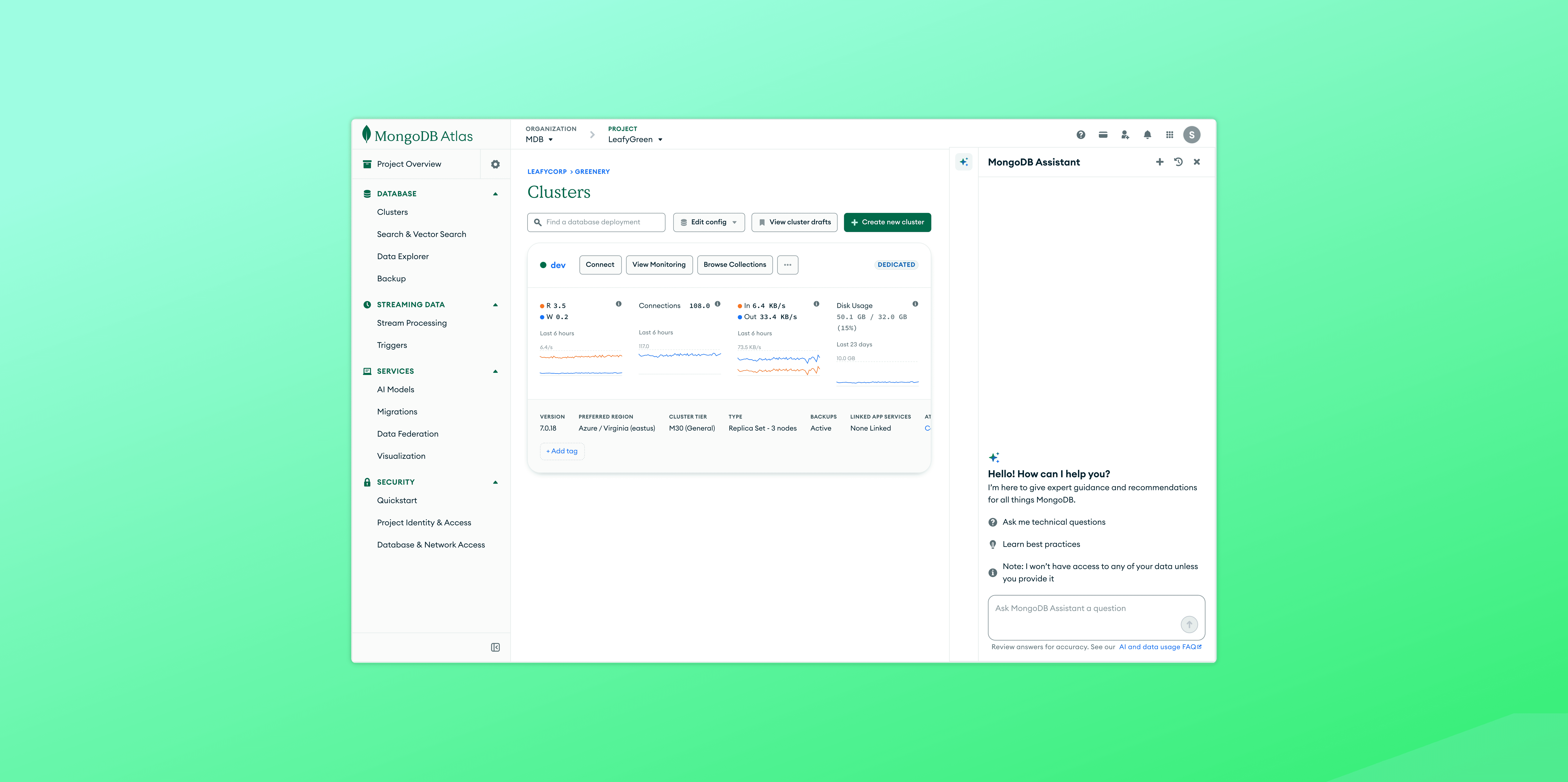
ROLE
Product Design Lead
COMPANY
MongoDB
CATEGORIES
AI, B2B, Developer Tools
TIMELINE
Q3-Q4 2025
Overview
Goals
Deliver a scalable, trustworthy, and unified AI assistant experience across MongoDB. Create components, design/copy/brand guidelines, and success metrics, while laying the foundation for long-term agentic capabilities.
Core Team
Program Manager, Product Manager, UI Engineer, AI Engineer, and me
6.4M
Conversations since launch
5.3%
Lift in atlas registrations
2.4x
more likely to create a paid cluster
11
Product Teams collaborated
Problem
Business Context
AI-powered chat was rapidly becoming an expectation across developer tools. Internally, this created urgency and risk: several MongoDB teams had already begun building their own embedded assistants in isolation, each with its own visual language, copy, and interaction patterns. Left unchecked, this would have meant:
Duplicated engineering and design investment across teams
Inconsistent user experience as customers moved between MongoDB surfaces
No shared source of truth for how "the assistant" should look, sound, or behave
Constraints
Multiple product surfaces, many stakeholders, one team's bandwidth: I was designing an experience meant to scale across MongoDB's products, marketing site, community forums, and education sites. This meant I had to work with a large set of stakeholders and design for various use cases while directly supporting individual product teams' launches.
A moving target: The assistant's product roadmap meant I was designing foundational patterns that needed to hold up under future capabilities we hadn't built or defined yet.
Technical barriers: The assistant couldn't yet identify a logged-in user or interact with users' data. It had no robust reporting layer or way to hand off a live conversation to our support team. This meant our existing experience didn't meet internal stakeholder or user needs.
I want it to become an assistant not just for solving your problem, but an assistant to teach you as well.”
Participant #8
Foundational Research
Moderated Interviews
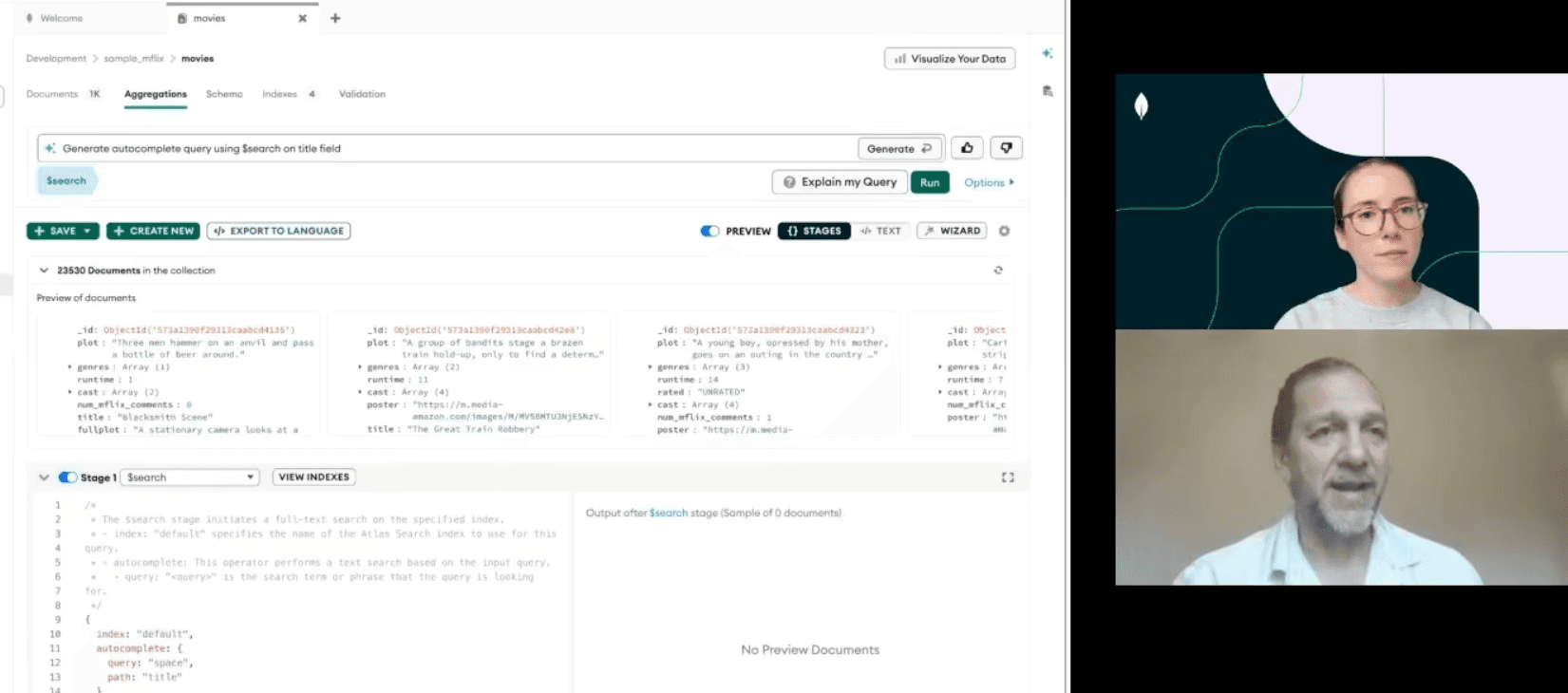
I co-ran a research study to ground my decision in real user behavior. This consisted of 13 hour-long moderated interviews with a mix of developers, CTOs, engineering managers, and AI engineers. We explored users’ trust, adoption, and expectations for an embedded AI assistant within MongoDB Atlas and Compass.
Conversational Analysis
I individually synthesized 6 months of support conversation data (with the support of AI✨) to understand what users were struggling with. This surfaced patterns like cluster downtime, failed upgrades, and billing confusion as the top reasons people reached for a chat interface in the first place.
finding 1
Users expect robust features
Users expect the assistant to help with way finding, data insights, and personalized performance improvements. They additionally expect it to be context aware. We used these insights to prioritize and design the most high impact features.
finding 2
As risk increases, so should user oversight
Users want minimal oversight for low risk actions, but require the ability to preview, edit, and undo actions that could have any impact on their product environment
finding 3
Users want recommendations reflected inline
Users want to see where changes will occur in the product UI so they get a more thorough idea of what the assistant is changing
finding 4
Users get easily overwhelmed with technical details
Users overwhelmingly preferred to get a relatively concise 3-4 paragraph overview and suggested follow up questions rather than see a full technical explanation for each question
Design Systems and UX Solutions

A shared component library, guidelines, and governance process (not just a style guide)
Established intake, review, and governance processes to ensure all assistant feature work fit within our standards.
Strict parameters for React components to enforce consistency where needed
Thorough interaction, content, and branding guidelines
Trade-off: This added process overhead; I mitigated this by offering a fast-track path for urgent requests
Note: The public style guide does not include branding, governance, or engineering guidelines.

A risk-based framework for how much control the assistant hands to the user
This framework helps engineering, product, and design teams to ensure they're baking in the right amount of user oversight when building new AI features.
Trade-off: In some instances this requires additional user oversight, but users are happy to take this on for important tasks

Affordances to show changes inline and easy undos for high-risk actions
Users didn't trust AI-generated changes they couldn't see applied in context and a visual diff in their code made changes "easy to understand and trust."
Trade-off: Requires more engineering investment per surface (inline edit affordances, rollback logic) so we created a framework for when this is necessary
Conversational Design Solutions

Updates to conversational flow
We wrote instructions for the assistant to shorten and simplify assistant messages in response to user feedback and provide sample follow-up questions for those who want more information
I wrote a plan to flag and hand off relevant conversations to our live support and sales representatives. *Engineering work for this is currently in progress.

Methodology for assistant response quality tracking
Correctness score for a bank of question and answer pairs submitted and vetted by subject matter experts across the company
Product managers could see the MDB Assistant’s score for any grouping of these questions and compare to the accuracy of other 3rd party AI tools. If incorrect answers were flagged, the AI engineers created a process to correct any inconsistencies.
Impact
Organizational Impact
This project created a shift from independent, team-by-team assistant efforts to a single governed design system with an intake and approval process for new AI features. This is a structural change to how MongoDB builds AI features, not just what they look like. Additionally, MongoDB created a new team focused on AI innovation with myself and another staff designer leading the vision. Through our research we were able to create a prioritized roadmap for future assistant capabilities beyond the initial tools that were launched.
Developer Tools
Assistant use has increased by 104% since its launch in our developer tools showing users are finding it increasingly valuable.
Cluster Creation
Users who interacted with the assistant to help with cluster creation were 2.4x more likely to create a paid cluster.
Education
Users maintain 8k-9k conversations weekly through the MongoDB Documentation site. This means ~5% of visitors to our Documentation engage with the assistant.
Marketing
Embedding the assistant onto marketing pages drove a stat sig 5.3%+ lift to Atlas registrations.
Reflection
What I'd do Differently
I would come to leadership with a proposal rather than a problem. I flagged that redundant work was happening before this project was formally assigned to me. If I had begun working on a solution before this work was prioritized, we could have prevented some of the overlapping work.
What's Next
The newly established AI Builder Experience team will continue expanding the assistant's capabilities as well as our our MCP server's capabilities, and MCP UI components. We aim to deliver a seamless experience using AI with MongoDB both within our tools and using 3rd party tools. We've begun running brainstorming sessions with various teams to understand which capabilities need to be prioritized next.
